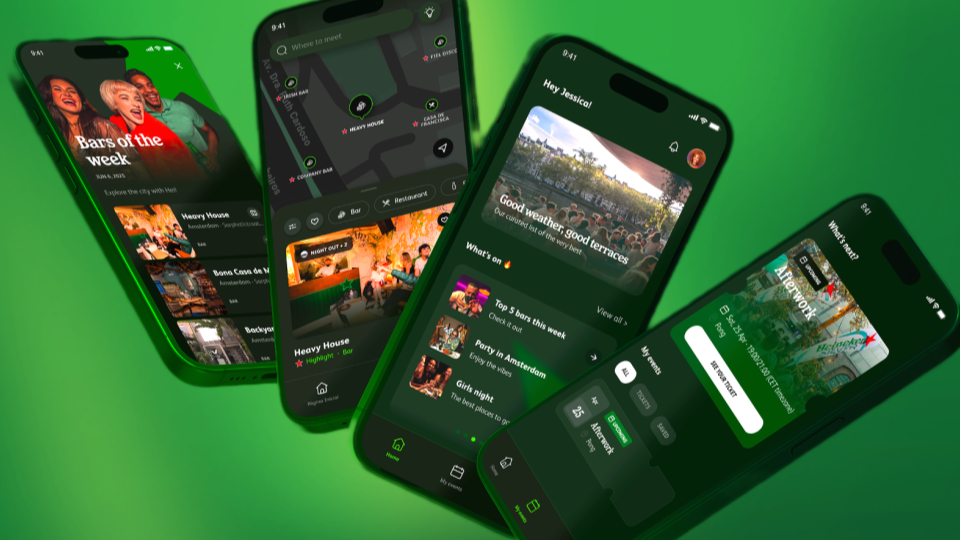
Hei Platform
- Year
- 2026 – ongoing
- Client
- Heineken Global
- Agency
- LePub / LeGarage
- Sectors
- Food & Beverages Hospitality & Experiences
- Services
- Product Strategy · Platform Strategy · Experience Strategy · Service Design · Growth & Go-to-Market
- Role
- Product Innovation & Strategy Lead
Reframing a fragmented consumer app into a coherent growth platform for consumers, venues and Heineken.
Hei started as Heineken's consumer-facing digital app, but the opportunity was bigger than improving individual features. My role was to turn ambiguity into a clear product strategy that connected consumer value, venue value and Heineken's commercial ambition.
The gaps
Hei had many initiatives. It didn't yet have one product thesis.
Over time, different ambitions had accumulated around the platform: brand campaigns, promotions and rewards, event discovery, venue activation, consumer acquisition, loyalty, integrations and new experience formats.
Individually, many of them made sense. Together, they were pulling Hei in different directions that created three fundamental gaps.
Consumer gap
Hei needed a reason to be useful between Heineken campaigns, not only when the brand had something new to promote.
Venue gap
Bar owners needed more demand and visibility, but had limited time and capacity to become marketers, content creators or experience designers.
Business gap
Heineken was investing in multiple initiatives without one clear model connecting product usage to on-trade traffic, venue value and commercial growth.
The challenge was not anymore 'what should we add to Hei?’ but ‘What should Hei exist to do?’ and ‘what should hei deliberately not become?’
The dots
A shared direction for competing needs
The work involved a digital product with different value questions for consumers, venues and Heineken. My focus was to make those questions explicit so the product conversation could connect user relevance with the needs of the business.
My contribution
I separated the value questions for the three groups and developed a scenario-based business case. I also defined evidence gates to support decisions about building, scaling, changing or stopping.
My Product Owner responsibilities sat within the wider LeGarage / LePub team, alongside collaboration with UX/UI designers. This case describes my strategic contribution; it does not claim sole ownership of implementation or wider team outcomes.
Three perspectives to connect
Relevance
What makes the experience useful enough to choose?
Participation
What makes it worthwhile for venues to take part?
Value
What would justify further investment?
A simplified illustration of the framing, not an original project deliverable.
The connection
Making the next decision explicit
The business case set out scenarios rather than treating future performance as a fact. The evidence gates created a structure for deciding what the team would need to learn before committing to the next step.
Making it real
What the work produced
A clearer framing of the product’s different value questions, a scenario-based business case and an evidence-led decision structure. These are completed contributions, not claims of achieved adoption, revenue growth or product-market fit.